
IN THE CLASSROOM
Classroom teaching is one of my favorite parts of my job. I get to flex my creative muscles planning my lessons and teaching aids, and of course also when a student chimes in with a question I didn’t expect. Let’s be honest, the most gratifying thing is being in a room full of people who are having a lively Q&A or group discussion about a topic you’re passionate about!
As a teacher, I’m not just here to feed students information. I’m here to provide tools, options, practice, critique, and encouragement until we find what makes the ideas “click and stick” in their minds. It’s cliché, but you can see that lightbulb moment when a student just gets it for the first time. I want every student to relish that feeling of success, and I do what I can to diversify my learning assessments so each student has a venue to showcase their progress.
I spent two wonderful years as a Graduate Student Mentor in my department at UMich, teaching graduate student instructors new strategies for improving their pedagogy and managing their classrooms. I’m always looking to grow in my teaching practice!
–Anonymous student
“Allison was the most prepared, most knowledgeable, and most engaging GSI I’ve met in my time at UM”
–Anonymous student
“The labs were very creative and really put into work the lessons taught. it was the perfect way to solidify the theory we learned”
–Anonymous student
“I enjoyed this class even though I am not the most comfortable with math and numerical analysis.”

OUT OF DOORS
There’s nothing quite like taking a class outside to pick apart all the stories contained within their local landscape. Observing complex Earth systems firsthand is one of the best ways to solidify the theoretical learning students do in class. Not only that, but the practical skills they learn will help them as they go on to do field camp as upperclassmen or even take jobs with a significant outdoor component. Setting students up for early success in a low-stakes, high-support class environment is crucial. Plus, it can just be so much fun!
I recognize that sometimes “nature” is not a place where every student feels inherently welcomed. As instructors, we have a lot of agency to improve the culture, safety, and accessibility of our field sites by emphasizing disability inclusive curriculum, anti-racist principles, and zero tolerance for harassment.
AGU’s “Unlearning Racism in Geoscience” program has compiled articles and resources on the subject that I highly recommend giving a read. Find them on the resources page under “Racism and Inclusivity” and “Racism and Accessibility” (also consider reading through the rest of the curriculum!)
PUBLIC EDUCATION
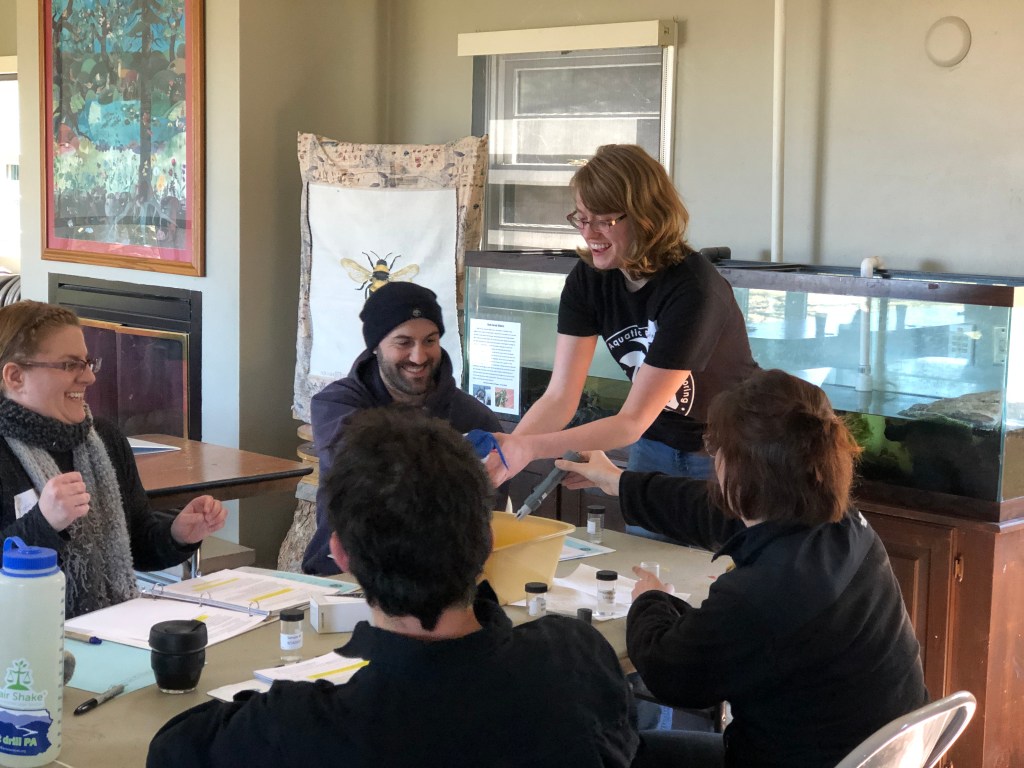
I became an Earth scientist in the first place because I got a job with the Alliance for Aquatic Resource Monitoring, training citizen scientists to monitor the health of their local waterways. It took me on trips across state lines to give presentations, lead hands-on trainings, and work with local officials on stream health initiatives. This was my “aha!” moment: Putting science into someone’s hands can change their life and their communities for the better! The Earth sciences touch our lives viscerally every single day, whether or not we’re attuned to it. This planet gives us so much to be grateful for, and I think education is one of the best ways to inspire a spirit of conservation in the general public.
There are a lot of misconceptions out there about how science is done and by whom. Maybe more than the actual content of whatever my outreach event is, I want people to take home one lesson: science is done by real people just like you who care deeply about what they do. This is why I especially love to get in front of students high school age and below–the leak in the pipeline for minority and minoritized students starts early. I want STEM-interested youth to feel excited about continuing their science education and to know that someone is on their side! With the right support in their education, anyone can become a more critical consumer of information and even become a scientist themselves!

 Dr. Allison Nicole Curley